
Flexagons
Flexagons are folded paper constructions that are fun to flex to reveal hidden pictures.
There are many kinds of flexagons. A tetraflexagon is typically square. Each square face is composed of four small squares. A simple tri-tetraflexagon can reveal three faces. A hexaflexagon is typically hexagonal. Each hexagonal face is composed of six small triangles. A simple tri-hexaflexagon can reveal three faces. A hexa-hexaflexagon can reveal six faces. Each face may appear in different configurations — different orientations of the small leaf faces. It is fun to flex a flexagon and try to find all faces in all possible configurations.
Here's a pretty Hexa-hexaflexagon Pattern (PDF) that I created. The document contains:
- Instructions for making and pinch-flexing a hexa-hexaflexagon.
- A blank hexa-hexaflexagon pattern. Decorate your own hexa-hexaflexagon.
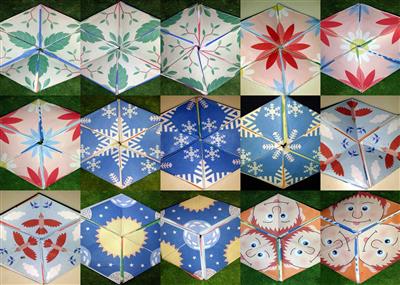
- A decorated hexa-hexaflexagon pattern with six faces: flowers, leaves, snowflakes, people, planets, and birds. The decorations are designed to make it easy to identify the six faces and their different configurations.

The three primary faces (flowers, leaves, snowflakes) each have three configurations. The three secondary faces (people, planets, birds) each have only two reachable configurations. Can you find all 15 configurations by pinch-flexing your flexagon?
[Photo by Daniel Eaton]
Flexagons were discovered by Arthur Stone in 1939, and popularized by Martin Gardner in 1956.
You can learn a lot more about flexagons elsewhere — just search for "flexagon". I like this book, which is quite comprehensive: The Secret World of Flexagons by Sherman, Elran, and Schwartz (2025).